
2026-11-12
Organic versus bio-organic: one extra step
A bio-organic fertilizer line uses the same equipment as an ordinary organic fertilizer line. The difference is one step: a microbial inoculant is added at composting. That step decides how fast the material composts and how good the finished fertilizer is.
| Line | Process |
|---|---|
| Organic fertilizer | Collect raw material → pile and compost naturally → crush → screen → premix → granulate → dry → cool → screen → pack |
| Bio-organic fertilizer | Collect raw material → add inoculant and compost → semi-finished compost → crush → screen → premix → granulate → dry → cool → screen → pack |
Problems with natural composting
- It takes a month or more.
- Nutrients are lost during the long composting period.
- It smells and pollutes the surroundings.
- The product is often wet, sticky and smelly, awkward to apply, and can burn roots and seedlings.
- It carries many unwanted microbes that consume nutrients and spread crop disease.
What a composting inoculant changes
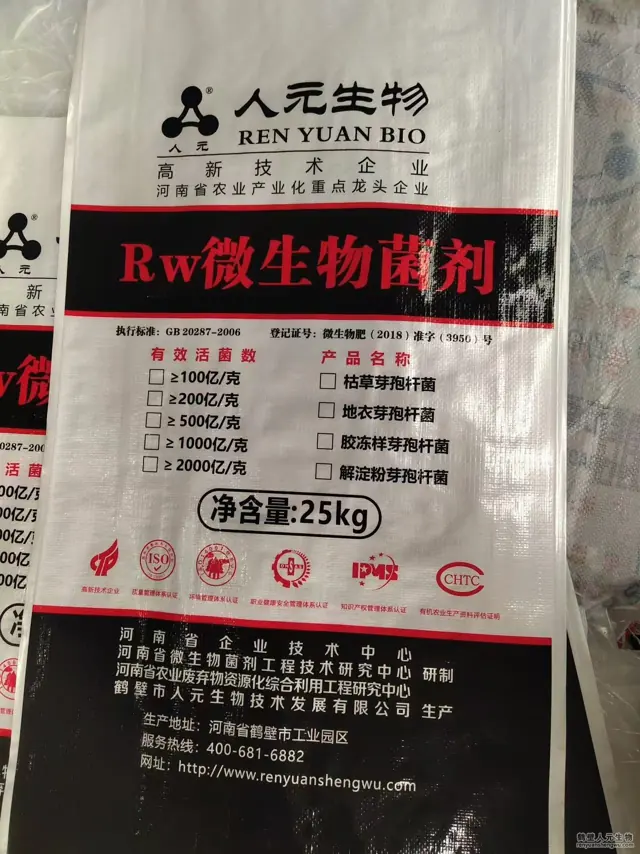
Renyuan develops and produces microbial inoculants as well as equipment. Its Rw composting inoculant combines more than ten bacterial and fungal strains that work together without antagonism. The product documentation states:
- Viable count of at least 12 billion per gram.
- About 1 kg of inoculant treats 10 tonnes of raw material.
- At 15 °C or above, the pile heats up in 24–48 hours, the odour is gone in 2–3 days, hygienisation is complete in 5–7 days and the material is fully mature in 12–15 days.
- Composting is aerobic and can be done in the open: once the pile heats up, it only needs turning.
Composting also multiplies functional microbes in the material. Renyuan also supplies functional strains for bio-organic fertilizer; see the related products below.
Equipment for a bio-organic fertilizer line
Mixing the inoculant evenly through large volumes of manure is the job of the turner. A crawler turner works windrows on open ground; a trough turner works walled troughs. Either one also speeds up composting through regular aeration. The finishing equipment, from crusher to packer, is the same as for an organic fertilizer line.
Why buyers source equipment and inoculant together
Renyuan runs a provincial engineering research centre for microbial inoculants and pilot lines for powdered and granular bio-organic fertilizer at its trial sites. Buyers can discuss the composting recipe and the equipment layout with one supplier, so the inoculant dose and turning schedule are planned together with the turner selection.
Renyuan equipment for this line
- Rw Bio-Organic Fertilizer Fermentation Inoculant
A liquid mixed-microorganism preparation for fermentation of livestock manure and other organic materials.
- Rw Composting Accelerator
A microbial preparation for aerobic composting of livestock manure and other organics, described for coarse-fibre and lignin-rich materials.
- Functional Microbes for Bio-Organic Fertilizer
A microbial input for bio-organic fertilizer production with nitrogen-fixing, phosphate- and potassium-solubilizing microorganisms.
- RY-ZFP Standard Trough Compost Turner
The standard RY-ZFP series turns and mixes organic material in fixed composting troughs. The 40/50 and A/B combinations have different widths, working depths and main motor ratings, so selection begins with the trough geometry.
- RY-LFD Series Crawler Compost Turner
RY-LFD crawler turners mix and aerate composting windrows across several working widths. Start with windrow width, then check site access and the turning requirements of the selected model.
- Granular Organic Fertilizer Production Line
Produce organic fertilizer granules from prepared, composted ingredients. Mixing, granulation, drying, cooling, screening and bagging are arranged around the formulation and target granule.
Frequently asked questions
What is the difference between organic and bio-organic fertilizer production?
The equipment is the same. A bio-organic line adds a microbial inoculant at composting, which shortens composting and improves the finished product.
How much inoculant does composting need?
Renyuan's Rw inoculant documentation states about 1 kg per 10 tonnes of raw material.
How long does composting take with an inoculant?
At 15 °C or above, about 12–15 days to full maturity, according to Renyuan's Rw inoculant documentation.