
2026-11-12
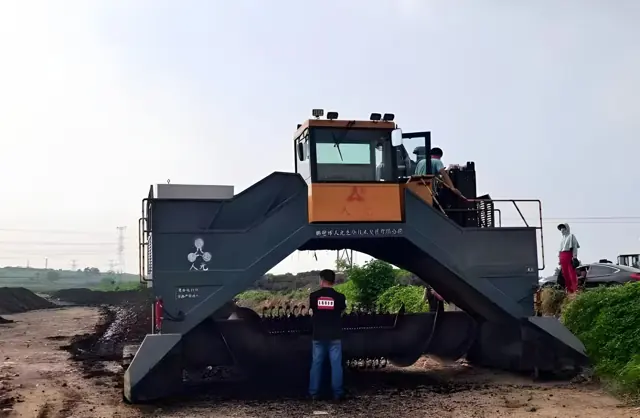
Why cattle farms process manure into fertilizer
A dairy cow produces more than 7 tonnes of manure a year, and beef cattle about 5–6 tonnes. Spread raw, cow dung heats up in the soil, uses up oxygen and can burn roots and seedlings. It also carries parasite eggs and pathogens, and it smells, especially in hot weather.
Dry cow dung contains about 10–20% crude protein, 1–3% crude fat, 20–30% nitrogen-free extract and 15–30% crude fibre. Composted properly, it loosens compacted soil and improves soil fertility, and it gives the farm a product to sell.
Two ways to set up the plant
- An open composting line with a turner, followed by crushing, screening and optional granulation. Investment is lower and the line is efficient, but some steps need operators.
- An enclosed aerobic fermentation tank. Material is loaded, aerated and composted inside the tank, and exhaust air passes through biological odour treatment. Renyuan's tanks range from 32 to 116 m³ of chamber volume.
Composting cow dung
Cow dung is wet, so moisture control comes first. Drain or air-dry the manure to below 85% moisture. Mix it with straw, sawdust or mushroom residue, with manure making up 80–90% of the mix. The composting mix should then be at 40–65% moisture.
To check moisture by hand, squeeze a handful firmly. Water should show between your fingers without dripping, and the lump should break apart when dropped. Too dry slows composting; too wet blocks air. If the mix is too wet, add straw, sawdust, mushroom residue or dry soil.
- About 48 hours after piling, the temperature rises to 50–60 °C. By day 3 it can pass 65 °C.
- Turn the pile at this high temperature. Composting normally shows two peaks above 65 °C, and turning twice is usually enough.
- Keep the temperature within 55–65 °C and keep the pile aerated. Without enough air the pile turns anaerobic and starts to smell.
- Composting is complete in about 7–12 days, depending on local temperature and how often the pile is turned. The material turns dark brown and cools to ambient temperature.
Ground windrows use a crawler turner. Composting pits or troughs use a trough turner.
Finishing: powder or granules
- Screen the composted material. The fine fraction can be sold directly as powder fertilizer.
- Send oversize lumps through a crusher and back to the screen.
- Granulate the screened material.
- Dry the granules to the required moisture. Smaller lines can omit this step.
- Cool the granules so that they store well.
- Lift the product to a finished-goods bin and bag it on an automatic weigher. Renyuan's reference layouts bag 3–6 bags per minute.
Sizing a cow dung line
Renyuan recommends a single line capacity of 1–10 t/h. A smaller line does not reach an economical scale, and a larger one makes raw material and product logistics harder. A 10,000 t/yr cow dung plant needs roughly 600–1,000 m² of floor area.
What to send us for a configuration
- Herd size, daily manure tonnage and how manure is collected
- Moisture of the manure as collected
- Bulking materials available locally (straw, sawdust, mushroom residue)
- Powder or granular product and planned annual output
- Whether the plant will be built on the farm site
Renyuan equipment for this line
- RY-YFD5000 Semi-Hydraulic Crawler Compost Turner
RY-YFD5000 turns and mixes manure, straw and other organic materials in open windrows for aerobic composting. Its semi-hydraulic crawler arrangement includes a split-frame lifting design; check both windrow dimensions and transfer space.
- RY-ZFP Hydraulic Trough Compost Turner
A hydraulic-drive trough turner listed with four RY-ZFP models and model-specific dimensions and motor data.
- Intelligent Aerobic Fermentation Tank
The aerobic fermentation tank combines a chamber, lifting feed system, aeration, hydraulics and biological odor treatment for manure and other organic materials. Compare chamber volume and the stated treatment quantity separately across the four sizes.
- RY-GS Trommel Screen
The trommel screen grades fertilizer material through a rotating screen. Use it after crushing for powder processing or in granule finishing, with apertures and recycle routes matched to the finished-product size.
- Disc Granulator
Forms fertilizer granules in a rotating disc and connects with mixing and downstream finishing stages.
- Rotary Drum Dryer
A rotary dryer for fertilizer materials, arranged with a heat source and dust-collection equipment as required.
- Rotary Cooler
Cools fertilizer material after drying or forming before screening, packing or storage.
Frequently asked questions
How long does cow dung take to compost?
Usually about 7–12 days with an inoculant and regular turning, depending on local temperature and turning frequency.
What moisture should cow dung be at for composting?
The composting mix should be at 40–65% moisture. Drain or dry raw manure to below 85% first, then add bulking material.
Do I need a dryer for cow dung fertilizer?
Not always. Powder fertilizer can be sold after screening, and smaller granular lines can omit the dryer. Larger granular lines dry the granules to the required moisture.